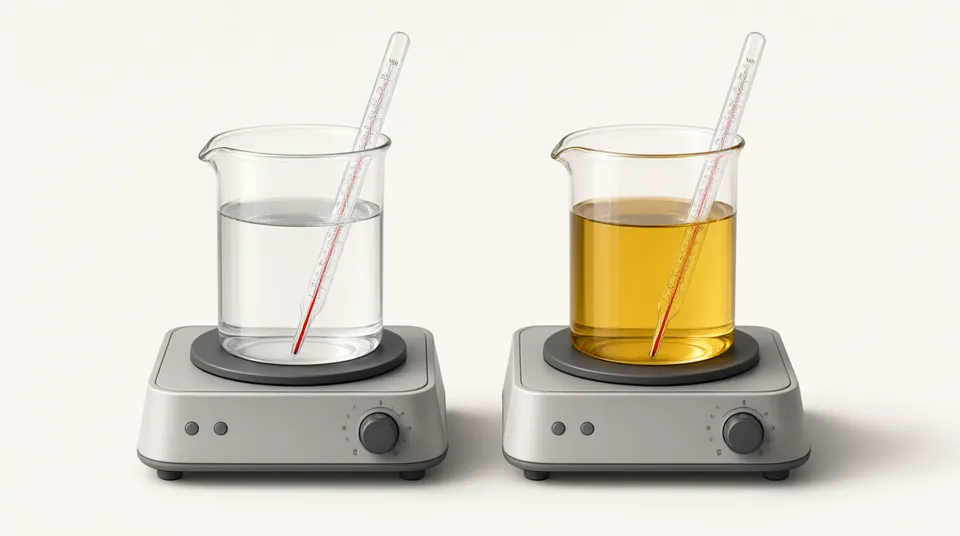
About this experiment
Equal energy inputs do not give equal temperature rises. Compare a water-like sample with a lower heat-capacity material to see how mass and specific heat capacity affect heating. The thermometer is a schematic indicator, and the numerical reading remains the quantitative result.
Learning goals
- Investigate how energy supplied affects temperature while controlling the other variables.
- Use the graph and numerical readings to test a prediction.
- Explain the physical assumptions and where this model stops applying.
How to use it
- 1Use 0.5 kg and 4200 J/(kg·K). Supply 21 kJ and check the rise is 10 K.
- 2Save the curve, then use 2100 J/(kg·K). Compare temperature rises for the same energy.
- 3Double mass at fixed specific heat capacity and supplied energy. Predict the new rise.
- 4Change initial temperature. Does the slope or only the intercept change?
The model
Assumptions
- Specific heat capacity is constant, all supplied energy enters the sample, and there is no heat loss.
- This model covers sensible heating only. High predicted temperatures do not include boiling, melting or temperature-dependent properties.
Try this in class
- Q1Why is a 1 K rise equal in size to a 1 °C rise?
- Q2How much energy raises 2 kg of material with c = 900 J/(kg·K) by 15 K?
Frequently asked questions
Does the sample boil at 100 °C?
No phase transitions are modelled. For water near boiling use the changes-of-state experiment instead; this model is a constant heat capacity extrapolation.
What is the difference between heat capacity and specific heat capacity?
Heat capacity belongs to the whole sample and has units J/K. Specific heat capacity is per kilogram and has units J/(kg·K).