About this experiment
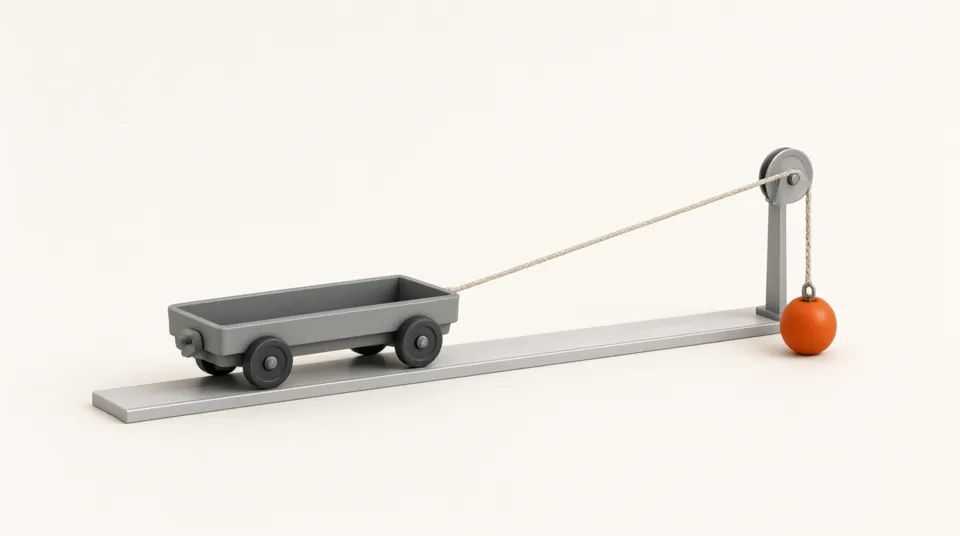
Newton's second law links a cause, net force, to a response, acceleration. Apply a signed horizontal force to a cart and compare force-acceleration lines for different masses. The arrow shows the direction of the net force, while the readouts predict motion after the selected time.
Learning goals
- Investigate how net force affects acceleration while controlling the other variables.
- Use the graph and numerical readings to test a prediction.
- Explain the physical assumptions and where this model stops applying.
How to use it
- 1Keep mass at 3 kg. Double force from 6 N to 12 N and compare acceleration.
- 2Select Acceleration, save the curve, then double mass to 6 kg. Compare slopes at the same force.
- 3Apply a negative force. Explain the signs of velocity and displacement.
- 4Set net force to zero. What does the model predict for this initially stationary cart?
The model
Assumptions
- Mass remains constant, the cart starts from rest, and the entered force is the net horizontal force.
- Weight and support force cancel vertically. Friction and air drag are absent.
Try this in class
- Q1What net force accelerates a 4 kg cart at 2.5 m/s²?
- Q2Why does twice the mass give half the acceleration at fixed force?
Frequently asked questions
Is the force the applied force or net force?
It is the net horizontal force after all horizontal forces have been added. In this model there is no resistance.
Does zero force always mean zero velocity?
No. Zero net force means constant velocity. This particular model starts from rest, so its velocity is zero when force is zero.