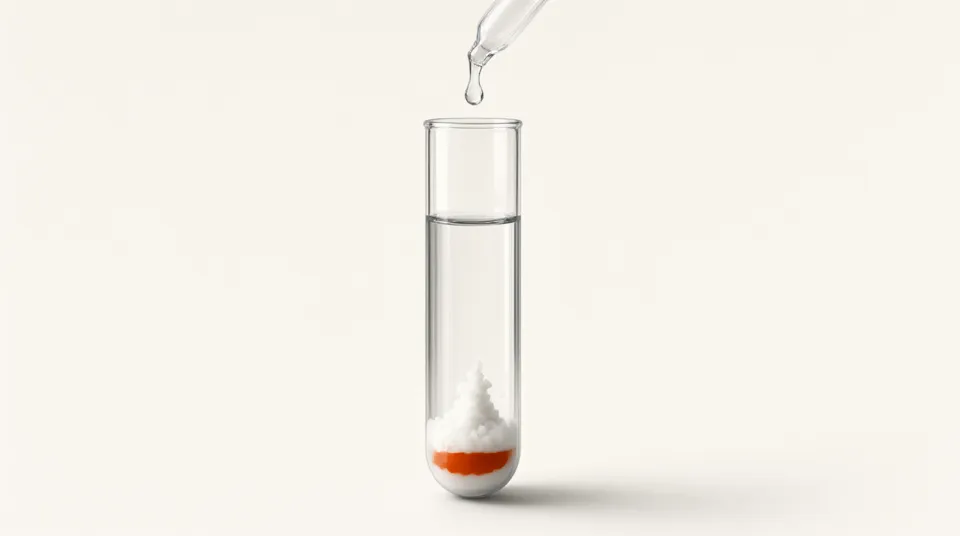
About this experiment
Mix ion solutions or add a finite solid dose to water with an optional common ion. Measure dissolved ions and remaining solid after equilibrium, including the correct stoichiometry for salts that release two anions.
Learning goals
- Compare the initial ion product with the solubility product.
- Apply stoichiometric depletion during precipitation.
- Distinguish saturated excess-solid equilibrium from complete dissolution of a finite dose.
How to use it
- 1Start with silver ions and add chloride solution in small increments.
- 2Record the equilibrium precipitate and free-ion concentrations after mixing.
- 3Compare calcium fluoride with a one-to-one salt and inspect its squared fluoride term.
- 4Switch to dissolution, remove the common-ion background, then add it again and compare remaining solid.
The model
Assumptions
- Teaching values at 25 °C are AgCl 1.8 times ten to the minus ten, BaSO4 1.1 times ten to the minus ten and CaF2 3.9 times ten to the minus eleven.
- Concentrations replace activities. Complexation, acid-base side reactions and changes of solid polymorph are omitted.
- Dissolution mode begins with 100 mL water; mixing mode includes both stock-solution volumes. Solid masses are determined by conservation, not by a visual grain count.
- Equilibrium is assumed after each addition. Grain appearance is amplified and has no nucleation or settling-rate interpretation.
Try this in class
- Q1Why can complete dissolution leave Q below Ksp?
- Q2Why does adding the same anion affect calcium fluoride differently from silver chloride?
Frequently asked questions
Does a small Ksp always mean a smaller molar solubility than another salt?
No. Stoichiometry changes how molar solubility enters the ion product. Compare dissolution equations as well as numerical Ksp values.
Does precipitation remove all ions?
No. A solid-present equilibrium retains nonzero dissolved concentrations satisfying the solubility product.