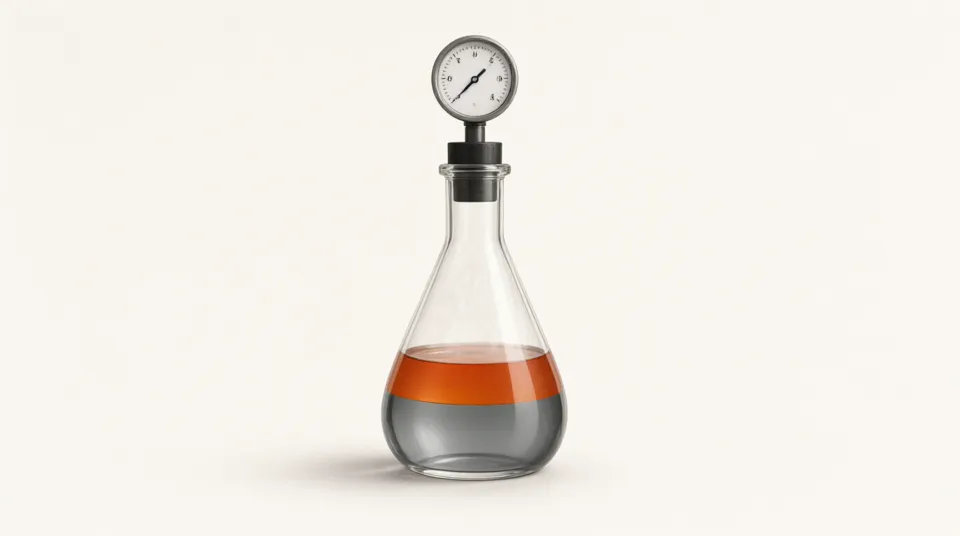
About this experiment
Mix two volatile components and compare partial pressures, total pressure and vapour composition. The more volatile component can be enriched in the headspace even when the liquid mixture is equimolar.
Learning goals
- Apply Raoult law to each liquid component.
- Connect partial pressure to vapour mole fraction through Dalton law.
- Distinguish bubble-pressure and dew-pressure curves at fixed temperature.
How to use it
- 1Compare pure toluene and pure benzene vapour pressures at one temperature.
- 2Mix equal liquid mole fractions and record the enriched benzene fraction in the vapour.
- 3Change headspace volume and compare pressure with the amount of vapour.
- 4Show the bubble-dew envelope and verify that the current liquid and vapour compositions belong to the same equilibrium pressure.
The model
Assumptions
- The liquid is an ideal large reservoir with prescribed composition, and the vapour is ideal. Finite depletion of the liquid and nonideal activity coefficients are omitted.
- Benzene uses Antoine coefficients 4.01814, 1203.835 and minus 53.226; toluene uses 4.08245, 1346.382 and minus 53.508. Temperature is restricted to 308.15 through 338.15 K.
- Headspace volume changes vapour amount at the same saturated pressure. Tracer colours represent composition, not actual number density or exchange kinetics.
Try this in class
- Q1Why is vapour benzene fraction greater than liquid benzene fraction in a mixed sample?
- Q2Why does changing headspace volume not change the saturated pressure in the large-reservoir model?
Frequently asked questions
Does this predict an ethanol-water azeotrope?
No. That requires a nonideal liquid model. The present ideal binary model does not produce an interior azeotrope.
Why do the bubble and dew curves have different horizontal compositions?
The bubble curve is parameterised by liquid mole fraction and the dew curve by vapour mole fraction. A horizontal tie line connects the coexisting compositions.