About this experiment
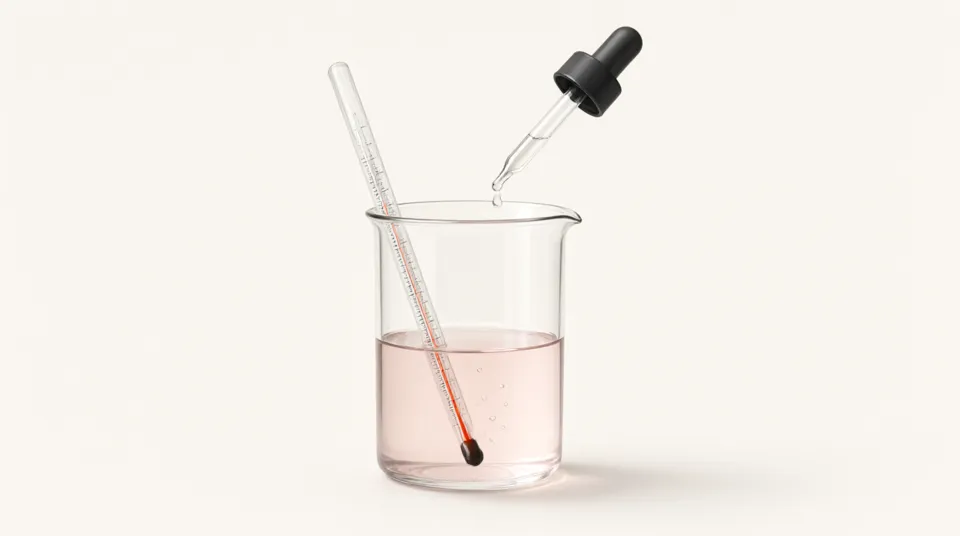
Deliver acid from a burette into a base and follow chemistry and temperature together. The dose controls remaining acid or base, the pH curve and the heat released. Beyond equivalence no additional neutralization heat is generated, while added liquid continues increasing the heat capacity.
Learning goals
- Identify equivalence by equal acid and base amounts rather than equal volumes alone.
- Relate neutralized moles to released heat.
- Explain why adding more acid after equivalence lowers the ideal temperature rise.
How to use it
- 1Predict the equivalence volume from the initial base amount and acid concentration.
- 2Add acid toward that dose, watching the pH, thermometer and displayed heat.
- 3Use Add 1 mL or the burette handle to inspect values around equivalence.
- 4Continue beyond equivalence, compare temperature and pH, then save several doses in the notebook.
The model
Assumptions
- Both acid and base dissociate completely. pH uses Kw = 10⁻¹⁴ at a fixed 25 °C reference, including water autoionization near equivalence.
- Neutralization releases a fixed 57.3 kJ per mole of water formed. Density is 1 g/mL, solution specific heat is 4.18 J/(g·K), and calorimeter heat capacity is 20 J/K.
- Heat loss, heats of dilution and temperature dependence of Kw are excluded. Altering a preparation setting starts a fresh mixture; the delivered-dose control and curve inspect the ideal accumulated-dose state.
Try this in class
- Q1Why is equivalence not generally reached by adding the initial base volume of acid?
- Q2Why does acid added after equivalence change pH without producing additional neutralization heat?
Frequently asked questions
Why is the equivalence pH exactly seven despite the small temperature rise?
pH is intentionally referenced to fixed Kw at 25 °C, while the heat model estimates the temperature change separately.
Does dragging the dose control physically remove acid from a real flask?
It selects a reproducible model state for that total dose. Lowering it represents a fresh smaller-dose comparison, not reverse titration.