About this experiment
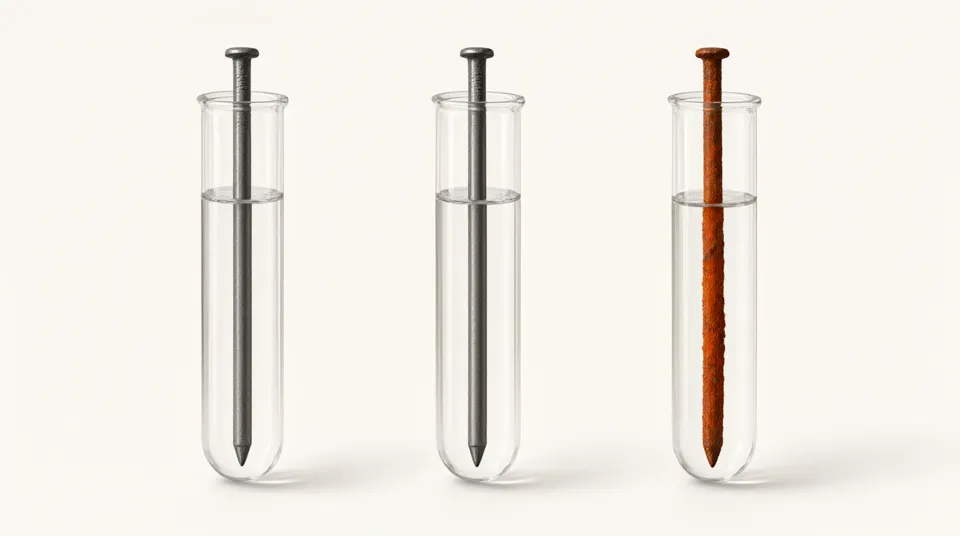
Compare iron under dry air, oxygen-free water, water and air, or salt water and air. Required conditions determine whether rusting occurs in the model, while salt changes its prescribed rate. A sealed headspace can run out of oxygen, connecting chemical change to a finite supply of reactant.
Learning goals
- Test whether water and oxygen are both required in the restricted model.
- Distinguish a rate change from a stoichiometric oxygen limit.
- Explain nail mass gain as oxygen incorporation rather than creation of iron.
How to use it
- 1Start exposure in dry air and in oxygen-free water. Compare their mass changes.
- 2Expose the nail to water and open air, then compare with salt water at the same time.
- 3Seal a small headspace and run to the end. Inspect its remaining oxygen.
- 4Increase headspace volume while keeping the same nail and compare the maximum possible oxidation.
The model
Assumptions
- The model converts iron to a dry Fe₂O₃ surrogate using 0.75 moles of O₂ per mole of Fe. Real rust is a variable mixture of hydrated oxides and oxyhydroxides. Water gates the model but is not weighed as part of the dry oxide.
- The prescribed rate is 0.025 per day times a salinity factor and relative oxygen fraction. It is illustrative and does not forecast the lifetime or corrosion rate of real objects.
- A sealed jar has ideal gas at 298.15 K and 101.325 kPa. Open air replenishes oxygen. Protective films, pH, galvanic contact, evaporation and water mass changes are excluded.
Try this in class
- Q1Why can a nail gain mass while the total mass of a sealed jar stays constant?
- Q2Why can extra salt stop affecting the final amount once oxygen is exhausted?
Frequently asked questions
Do the displayed days predict how quickly a real nail rusts?
No. The rate law is a chosen teaching model. Real rates depend on material surfaces and environmental conditions.
Does an open jar have unlimited oxygen concentration?
Its oxygen fraction stays at the selected value through replenishment. The amount consumed over time can exceed the initial amount in that headspace.