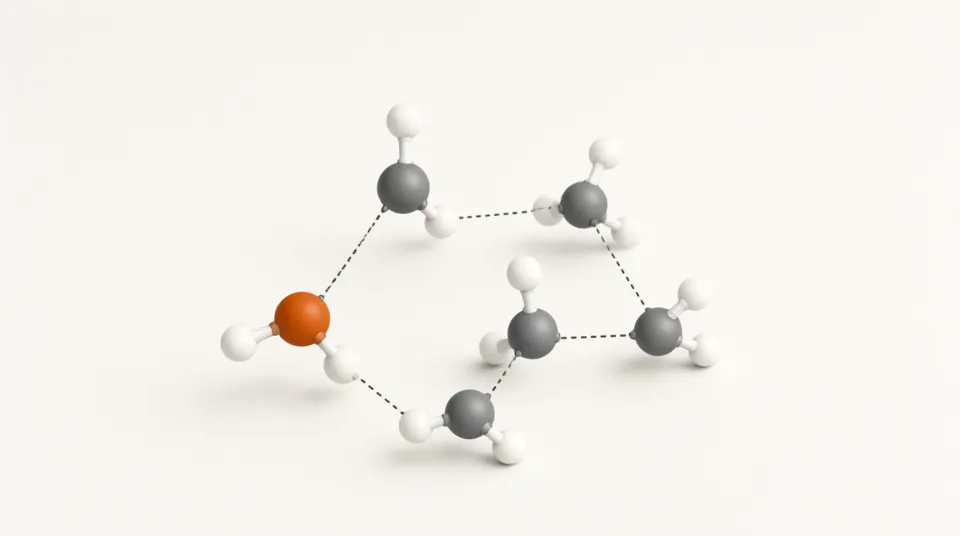
About this experiment
Pull molecular centres apart and turn their dipoles while measuring pair energy and radial force. Compare dispersion, dipolar orientation and a directional hydrogen-bond sketch without treating a pair potential as a bulk boiling simulation.
Learning goals
- Distinguish short-range repulsion from longer-range attraction.
- Explain how dipole orientation changes the interaction sign.
- Compare hydrogen-bond directionality with independent normal boiling-point reference values.
How to use it
- 1Use the nonpolar reference and find the Lennard-Jones energy minimum.
- 2Choose HCl and compare head-to-tail with side-by-side dipoles.
- 3Choose the water sketch and rotate a molecule away from the directional attraction.
- 4Change the toy interaction strength and confirm that the separately labelled reference boiling point remains unchanged.
The model
Assumptions
- The combined centre-based interaction is not a validated force field for a real liquid. The dipole approximation becomes inaccurate at molecular separations.
- The directional well sketches hydrogen-bond alignment; it is not an electronic hydrogen-bond calculation. Angles are imposed rather than advanced under torque.
- Normal boiling points are independent approximate NIST reference values at one atmosphere. They are not recalculated from modified pair parameters.
Try this in class
- Q1Why can equally strong dipoles attract in one orientation and repel in another?
- Q2Why is a single pair well insufficient to calculate a liquid boiling point?
Frequently asked questions
Are blue dipole arrows electron trajectories?
No. They indicate the chosen molecular dipole direction. The model does not animate or resolve individual electrons.
What happens when the hydrogen-bond term is disabled?
Its directional energy contribution vanishes, while dispersion, repulsion and any point-dipole contribution remain.