About this experiment
Connect a fuel cell to a load and follow gas consumption, water production and delivered electrical energy. Match the load resistance and discover when a finite reactant inventory runs out.
Learning goals
- Balance hydrogen, oxygen, water and electron amounts.
- Separate terminal power from total delivered energy.
- Explain internal resistance and the matched-load maximum.
How to use it
- 1Connect the load and record voltage, current and power.
- 2Set load resistance equal to internal resistance and compare power with nearby values.
- 3Run to fuel exhaustion and identify the limiting gas.
- 4Open the load before exhaustion and verify that water and past delivered energy remain.
The model
Assumptions
- Regulated ideal-gas feeds maintain an ideal 1.229 V reversible source at 298.15 K until a finite feed inventory is exhausted.
- Only a fixed internal ohmic resistance reduces terminal voltage. Activation and mass-transfer polarization are omitted.
- The accounting uses Gibbs free-energy release at the specified source voltage. Ohmic heat plus load energy equals that available free-energy decrease, not the full combustion enthalpy.
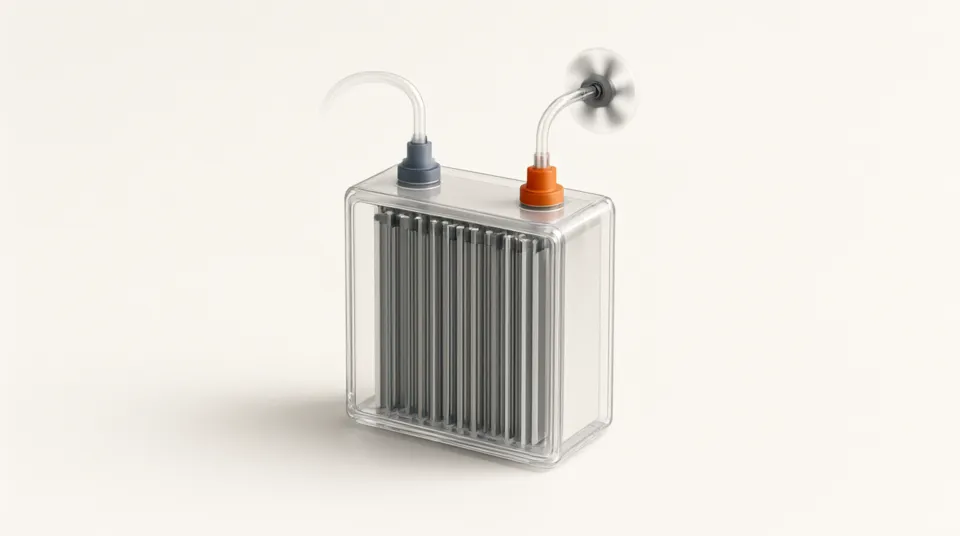
- The fan is a present-power indicator with no rotor inertia. Water and inventory gauges are magnified illustrations.
Try this in class
- Q1Why can a smaller load resistance increase current but reduce load power?
- Q2Why can oxygen remain after hydrogen is exhausted?
Frequently asked questions
Is this the full polarization curve of a real fuel cell?
No. It isolates ohmic loss and finite feed accounting. A real cell also has activation and mass-transfer effects.
Does electrical efficiency here refer to combustion enthalpy?
No. It is load voltage divided by the chosen reversible source voltage, so its reference is available Gibbs free energy.