About this experiment
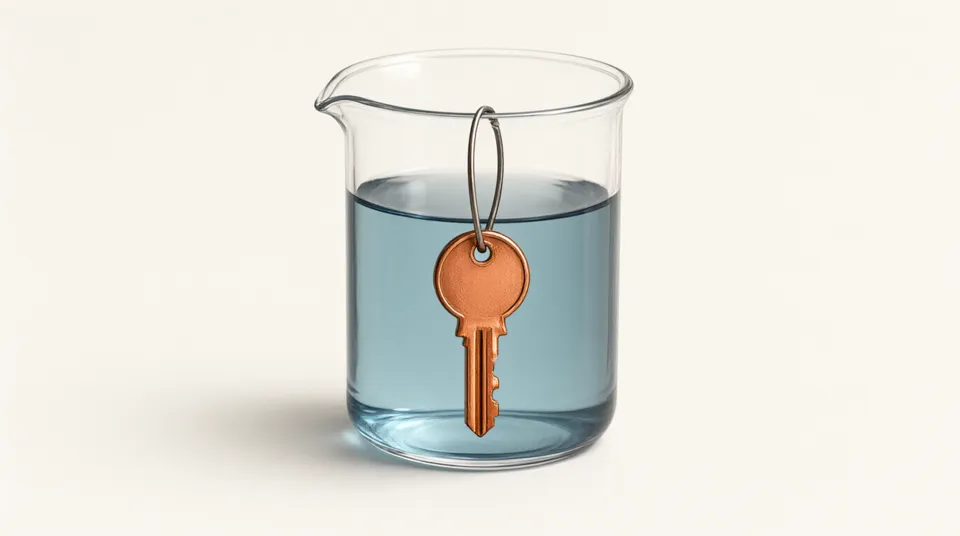
Plate a key, spoon or ring with copper. Measure the mean thickness, change surface area without changing charge and reverse polarity to strip an existing coating.
Learning goals
- Place the object at the cathode for copper deposition.
- Separate deposited mass from coating thickness.
- Account for copper in the object, counter electrode and bath.
How to use it
- 1Close the circuit with the object negative and sample a fixed supply-on time.
- 2Double the entered object area and compare thickness with deposited mass.
- 3Reduce current efficiency and compare cathode gain with anode loss.
- 4Make the object positive and follow the loss of its initial copper layer.
The model
Assumptions
- The acid-buffered bath has an effectively unlimited Cu²⁺ reservoir. The anode dissolves copper at full current efficiency.
- Cathodic current not used for copper deposition is assigned to hydrogen evolution. Bath copper therefore increases by anode loss minus cathode gain.
- Base-metal dissolution and precipitation are omitted. A reversed bare object carries no model current, and stripping stops when its initial copper coating is exhausted.
- Entered surface area determines uniform mean thickness using copper density 8.96 g/cm³. Shape geometry and the visible coating are illustrative.
Try this in class
- Q1Why can anode mass loss exceed object mass gain?
- Q2Why does doubling area halve thickness without changing the deposited mass?
Frequently asked questions
What happens when the object is positive?
The model strips only its supplied copper coating. It stops before making any prediction about the unmodelled base metal.
Does changing the drawn shape calculate a new area?
No. It changes the illustration. The separate entered area is the quantitative surface area used in the thickness calculation.