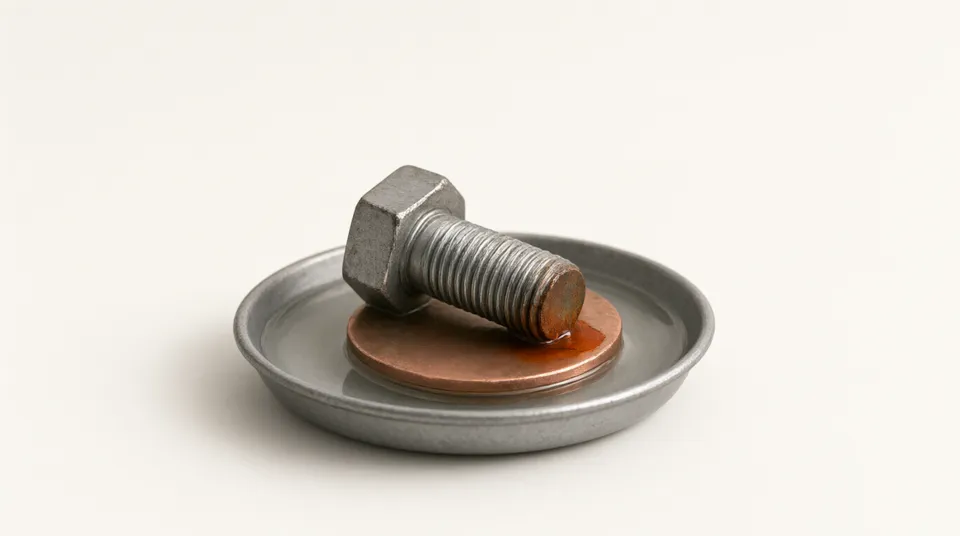
About this experiment
Expose iron to dry, wet or salty conditions. Apply a coating, couple a copper surface or connect sacrificial zinc, then measure which metal is consumed and when protection ends.
Learning goals
- Explain how water, oxygen and exposed area affect this corrosion model.
- Distinguish sacrificial zinc protection from copper coupling.
- Use finite charge capacity to estimate protection duration.
How to use it
- 1Compare dry, wet and salt-water exposure over the same interval.
- 2Cover part of the iron area and measure the smaller corrosion demand.
- 3Connect zinc and identify the initial interval with no iron loss.
- 4Use a small zinc supply and sample past its depletion, then compare copper coupling.
The model
Assumptions
- The model prescribes a constant neutral-water corrosion demand rather than calculating electrode polarization or localized pits.
- Wet current density is 10 microamperes per square centimetre, salt water multiplies it by four and copper coupling by three. Oxygen supply and uncoated fraction scale it linearly.
- Connected zinc supplies that demand until its finite two-electron oxidation capacity is exhausted. Remaining demand then oxidizes iron to Fe²⁺.
- Acid corrosion, zinc self-corrosion, oxide-film evolution and changing surface area are omitted. Rust-coloured marks exaggerate iron loss and are not a rust mass measurement.
Try this in class
- Q1Why can copper contact accelerate iron loss while zinc protects iron?
- Q2What changes after the sacrificial zinc is exhausted?
Frequently asked questions
Can these current densities predict the lifetime of a real structure?
No. They are illustrative settings for comparing mechanisms. Real corrosion depends on materials, geometry, electrolyte chemistry and evolving films.
Why does dry iron have zero demand here?
This simplified model requires a conducting water film and oxygen. It does not include other dry oxidation or acid pathways.