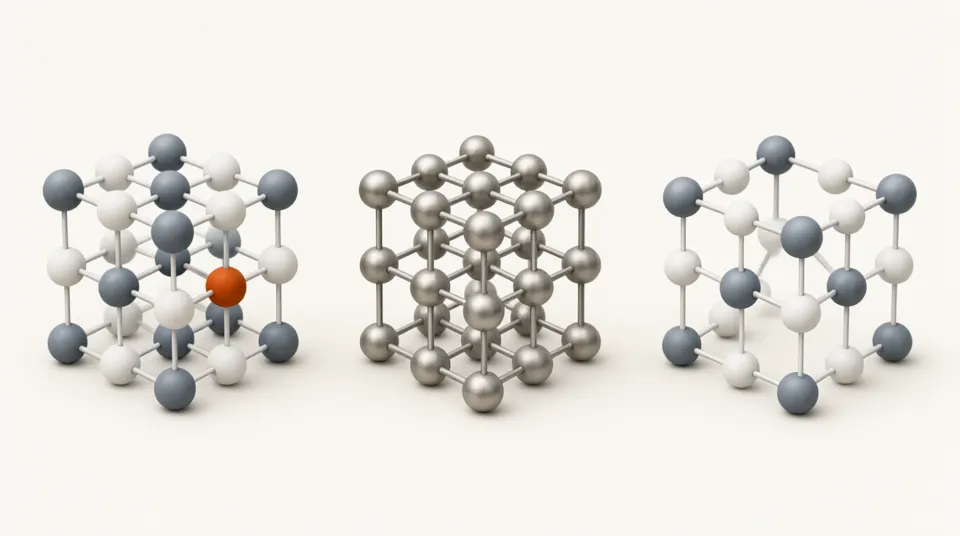
About this experiment
Rotate and expand a unit cell to inspect corners, faces, edges and body sites. Count shared particles, calculate packing and density, and distinguish a lattice of ions from a lattice of molecular centres.
Learning goals
- Count fractional contributions of boundary particles to one unit cell.
- Relate hard-sphere contact to cubic lattice parameter.
- Distinguish particle count from formula-unit count in an ionic crystal.
How to use it
- 1Select an FCC corner and face site and compare their shared fractions.
- 2Expose hidden sites and verify four effective particles in the FCC cell.
- 3Switch to BCC and compare packing with the FCC result.
- 4Inspect the rock-salt cell and distinguish eight effective ions from four formula units.
The model
Assumptions
- Monatomic structures use hard spheres. The rock-salt cell uses two FCC sublattices; its size prevents anion-anion overlap as well as unlike-ion overlap.
- The molecular option is a hypothetical simple-cubic lattice of dimer centres, not a claim about the structure of a real molecular solid. Its hard-sphere packing value is intentionally omitted.
- Visual expansion only separates the drawing. Density and contact geometry always use the unexpanded model cell. Thermal motion and lattice energies are omitted.
Try this in class
- Q1Why does one corner sphere contribute only one eighth?
- Q2Why are there four formula units but eight ions in a rock-salt conventional cell?
Frequently asked questions
Does FCC always mean the same chemical bonding?
No. FCC names a geometric arrangement. The sites can represent atoms or one sublattice of ions; chemistry requires additional information.
Why can the rock-salt lattice parameter stop changing when the cation is very small?
At sufficiently small cation radius, the anion FCC framework reaches anion-anion contact before unlike-ion contact. The model takes the larger of those two minimum cell sizes.