About this experiment
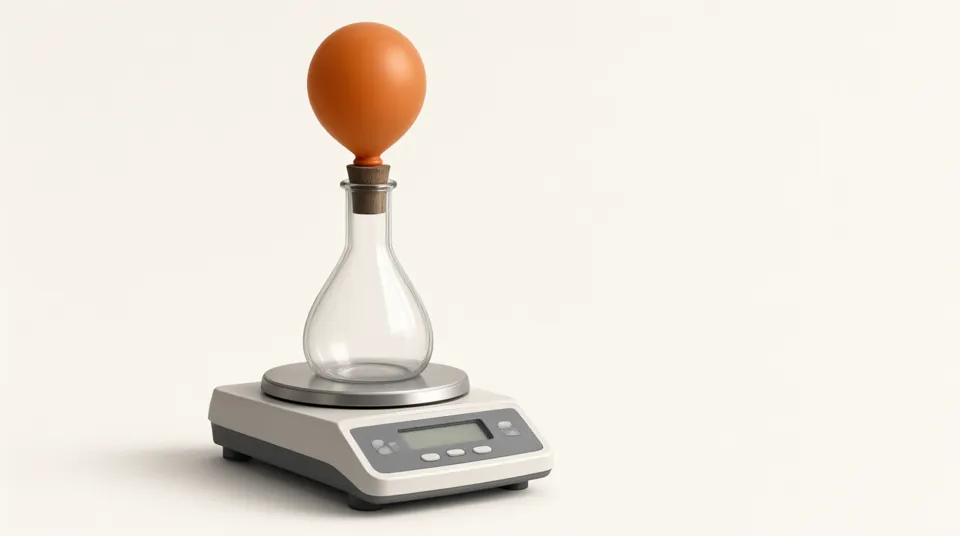
Mix baking soda with a selected amount of acetic acid while the complete apparatus rests on a balance. A closed balloon keeps the generated carbon dioxide inside the weighing boundary. An open vessel lets that material leave, changing the reading even though total mass across apparatus and room is conserved.
Learning goals
- Define the system boundary before interpreting a balance reading.
- Account for gas products as material with mass.
- Compare a mass change with the mass transported to the room.
How to use it
- 1Choose Closed with balloon and note the initial balance reading.
- 2Mix reactants, inspect gas formation and check the mass change.
- 3Prepare the corresponding open-vessel trial and compare its initial and final readings.
- 4Vary the acid amount, record escaped mass and explain the limiting-reactant ceiling.
The model
Assumptions
- Bicarbonate and acetic acid react one to one to form carbon dioxide. Prescribed progress is 1 minus exp(-0.06t). Gas molar mass is 44.0095 g/mol.
- Initial mass includes a 50 g vessel, 50 g acid solution and the selected powder; the closed setup also includes a 2 g balloon. Compare changes within each setup rather than comparing their different tare masses.
- Closed gas stays inside the weighed flexible collector at ambient pressure. Open gas escapes completely. Air buoyancy, evaporation, splashing and scale drift are excluded. A real inflating balloon can change apparent mass through buoyancy.
Try this in class
- Q1Where is the missing mass in the open-vessel reading?
- Q2Why must the balloon be included in the closed-system initial weighing?
Frequently asked questions
Is gas mass created from nothing?
No. Carbon dioxide contains atoms from the starting reactants. The gas mass is transferred out of the remaining reaction mixture.
Would a real balloon give a perfectly unchanged balance reading?
Not necessarily. Changing air buoyancy and instrument effects are excluded from this ideal mass-accounting model.