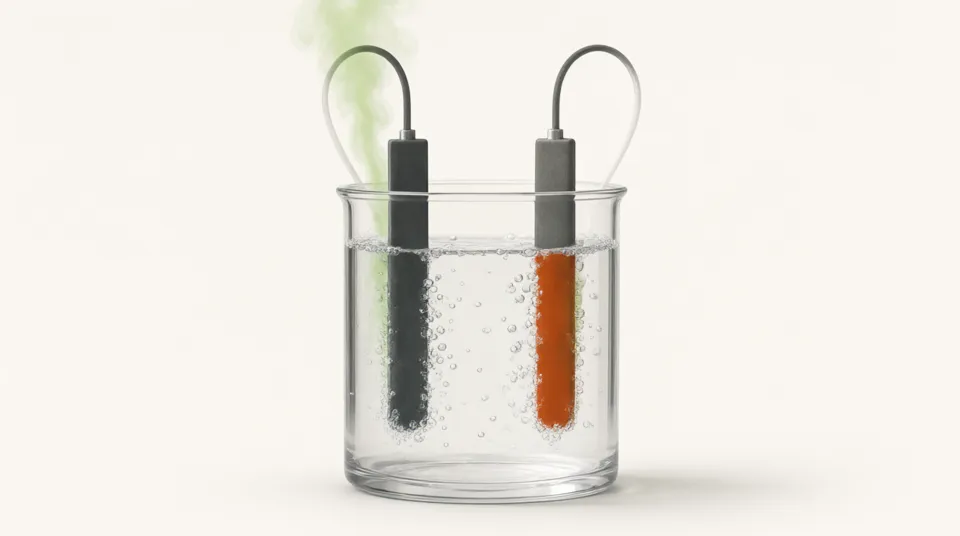
About this experiment
Close a brine cell circuit, collect the two gases and track salt consumption. Compare separated product chambers with an undivided model in which chlorine reacts with the hydroxide formed at the cathode.
Learning goals
- Balance charge and products in brine electrolysis.
- Explain why separation preserves chlorine and sodium hydroxide.
- Relate limiting salt inventory to maximum charge.
How to use it
- 1Keep the chambers separated and record equal hydrogen and chlorine volumes.
- 2Compare sodium hydroxide amount with the amount of either gas.
- 3Remove separation and repeat the same charge exposure.
- 4Increase exposure until the initial salt inventory limits further reaction.
The model
Assumptions
- Divided-cell electrolysis follows the net reaction 2 NaCl + 2 H₂O to H₂ + Cl₂ + 2 NaOH.
- The ideal undivided cold-cell pathway consumes all chlorine and hydroxide into hypochlorite, giving the net reaction NaCl + H₂O to NaClO + H₂.
- Oxygen evolution, chlorate formation, crossover and gas dissolution are omitted. The model is an ideal stoichiometric comparison, not a process design.
- Gas displays are capped visually at 250 mL while numerical totals continue. Gas volumes use 298.15 K and 1 bar.
Try this in class
- Q1Why do the net salt requirements differ between divided and undivided pathways?
- Q2Why is a large gas-volume total not evidence of unlimited salt supply?
Frequently asked questions
Why does the chlorine collector remain empty without the separator?
The chosen undivided model immediately consumes chlorine into hypochlorite. It does not model a partial reaction or gas escape.
Are bubble counts a measurement of gas amount?
No. Bubbles are an activity cue. Use the numerical gas totals derived from charge.