About this experiment
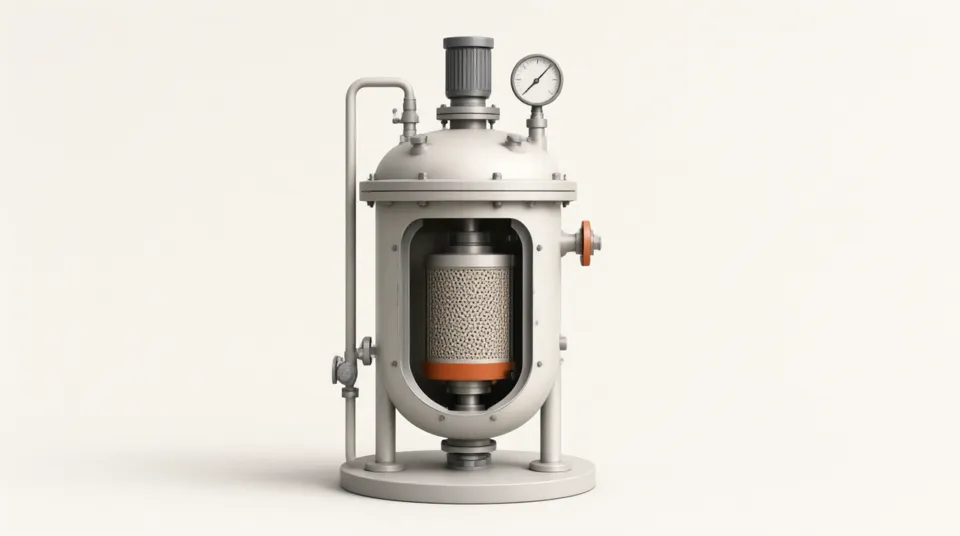
Explore the tradeoff between ammonia equilibrium yield and approach speed. Change pressure, temperature and feed ratio, then compare what adding a catalyst changes and what it leaves fixed.
Learning goals
- Relate pressure to the reduction in total gas moles during ammonia synthesis.
- Separate equilibrium conversion from finite-time conversion.
- Distinguish a catalyst effect on rate from an equilibrium shift.
How to use it
- 1Run the default reactor and compare actual with equilibrium conversion.
- 2Increase pressure at the same temperature and feed ratio.
- 3Lower temperature and compare the higher equilibrium yield with the slower approach.
- 4Add the catalyst and verify unchanged equilibrium conversion with faster finite-time production.
The model
Assumptions
- The feed contains one mole of N₂ and the selected H₂-to-N₂ ratio, with no initial ammonia. Pressure is held constant in an ideal-gas model.
- Constant standard enthalpy minus 92.22 kilojoules and entropy minus 198.75 joules per kelvin approximate the equilibrium constant for the reaction as written. Heat-capacity changes and gas nonideality are omitted.
- A phenomenological exponential relaxation approaches the computed equilibrium extent. Its Arrhenius rate scale is illustrative, and the catalyst multiplies it by eight.
- The apparatus is not an industrial reactor or safety-design model. Molecule samples illustrate composition; numerical inventories conserve nitrogen and hydrogen atoms exactly.
Try this in class
- Q1Why does higher pressure favour ammonia in this ideal-gas model?
- Q2Why can a catalyst improve finite-time conversion while leaving the equilibrium limit unchanged?
Frequently asked questions
Are the displayed yields precise industrial predictions?
No. The ideal-gas and constant-thermodynamic-property approximations isolate trends and omit important high-pressure and heat-capacity effects.
Does the catalyst alter the thermodynamic equilibrium constant?
No. It changes only the illustrative relaxation rate and leaves the computed equilibrium extent unchanged.