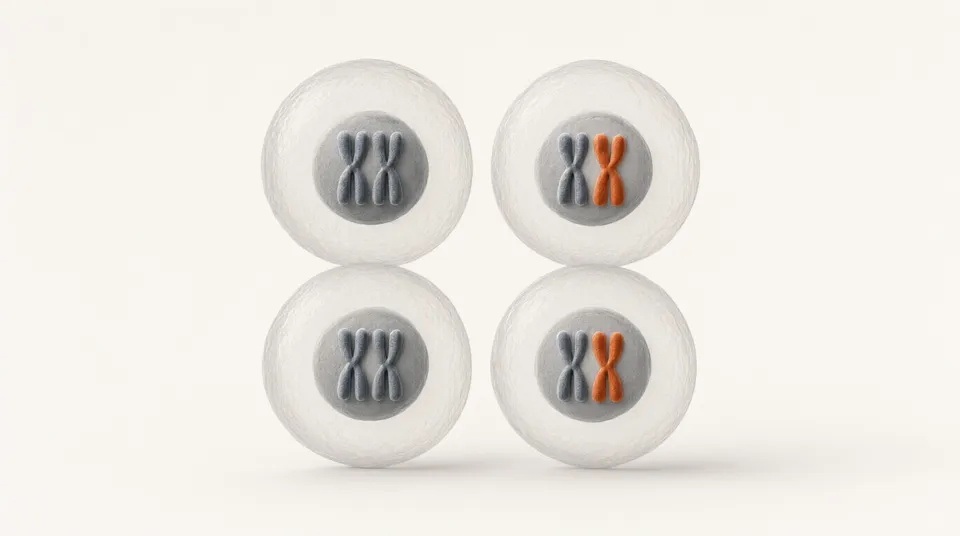
About this experiment
Orient homologous chromosome pairs and compare the products of two consecutive divisions. The first division separates homologs; the second separates sisters. An optional crossover between two linked loci shows how recombinant chromatids can appear alongside parental ones without an additional round of DNA replication.
Learning goals
- Distinguish homolog separation from sister separation.
- Account for DNA across one replication and two divisions.
- Relate homolog orientation and a defined crossover to gamete allele strings.
How to use it
- 1Inspect prophase I after replication and choose an orientation for each homolog pair.
- 2Enable one crossover in the AB and ab pair, then advance through the first division.
- 3Continue through meiosis II and inspect all four final products.
- 4Repeat with crossover off and a different pair orientation; record the allele strings.
The model
Assumptions
- DNA replication is already complete at the first snapshot. Total DNA is 4C throughout the tracked system, with 1C per final haploid product.
- The first pair carries AB and ab. A selected crossover swaps the distal locus between one chromatid from each homolog, yielding two recombinant chromatids. Other pairs carry C/c and D/d.
- The orientation pattern is deterministic, with two choices per pair. Chromosome loss, mutation, gene conversion and multiple crossovers are excluded. The selected crossover is an event, not a measured recombination probability.
Try this in class
- Q1Why is there no S phase between the first and second meiotic divisions?
- Q2Why does one crossover involve only two of the four chromatids in a homolog pair?
Frequently asked questions
Does 2ⁿ mean this one meiosis produces that many cells?
No. It counts possible homolog-orientation patterns across runs. One modeled meiosis produces four products.
Why are two parental and two recombinant AB products present after one crossover?
Only two non-sister chromatids exchange the selected segment. The other two retain their original combinations.