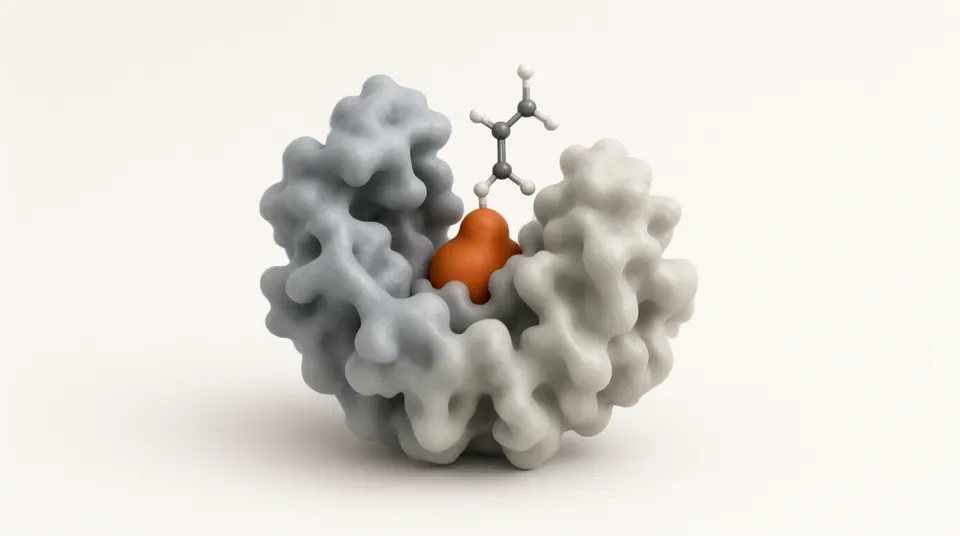
About this experiment
Measure how an enzyme reaction initially responds to increasing substrate concentration. Save a reference curve, change the enzyme concentration, temperature or pH, and compare rates. Substrate binding follows a Michaelis-Menten saturation model. The temperature and pH factors are explicitly chosen teaching curves, not fitted data for a particular enzyme.
Learning goals
- Explain saturation as substrate concentration increases
- Identify Km as the substrate concentration at half the current Vmax
- Distinguish enzyme concentration effects from changes in substrate concentration
How to use it
- 1Use 37 degrees Celsius, pH 7 and relative enzyme concentration 1. Set substrate to 2 mM and compare the rate with Vmax.
- 2Increase substrate to 20 mM. Notice that the rate approaches but does not reach Vmax.
- 3Save the reference curve, then double enzyme concentration. Compare the curves and Km.
- 4Change temperature or pH and compare with the reference. Return to the original conditions to see that these illustrative factors are reversible.
The model
Assumptions
- A single substrate reaction follows steady-state Michaelis-Menten initial-rate kinetics, with substrate in excess of enzyme.
- Substrate is held constant and product accumulation, depletion, inhibition and reverse product reaction are ignored.
- Km is fixed at 2 mM for all conditions. Enzyme concentration scales Vmax linearly.
- Temperature and pH multipliers are symmetric reversible teaching curves. They do not model actual denaturation, reaction history or a specific enzyme.
Try this in class
- Q1At which substrate concentration does the rate equal half of Vmax?
- Q2Why can adding enzyme increase the rate even when adding more substrate has little effect?
- Q3What measurements would be needed to replace the illustrative temperature curve with an enzyme-specific model?
Frequently asked questions
Does heating permanently damage the simulated enzyme?
No. The activity multiplier depends only on the current temperature and is reversible. Real enzymes may undergo irreversible denaturation, which is outside this model.
Does Km change when enzyme concentration doubles?
Not in this model. Doubling enzyme concentration doubles Vmax and the rate at every substrate concentration, while the half-maximum substrate concentration stays at Km.